Work · Case study · Instameals × Datadom
The AI Nutritionist, with Instameals.
- Location
- Ontario
- Industry
- Food Manufacturing · weekly subscription
- Engagement
- The AI Nutritionist, with its recommender, planner and coach · embedded as their AI and product team.
The client
Mohammad Sheikh co-founded Instameals in 2020 with the vision that healthy eating shouldn’t take effort. From a kitchen in Scarborough, his team cooks chef-made, ready-to-eat meals and delivers them every week across Ontario to thousands of clients. The menu changes weekly, and clients can pick the meals for their plan from a catalogue of dishes. Already at this point, the vision of making healthy eating an effortless endeavor was already well advanced.
The next logical step was to make the choosing effortless too, with a nutritionist in every client's pocket that already knows them and the meals they would enjoy.
Two problems in one product
Before starting building, we split the product along the three moments where the clients need help:
- Shaping a goal they are working towards
- Logging what they at (outside of their instameals)
- Choosing their meals weekly
The first and second moment are a planning and coaching problem, and it has to be measured on whether the advice is right. We built and benchmarked them separately, so each could be judged on its own terms, and then wired them into one product. The third moment is a recommendation problem, and it can be measured on what people buy.
Shaping the goal with nutritionist guidance
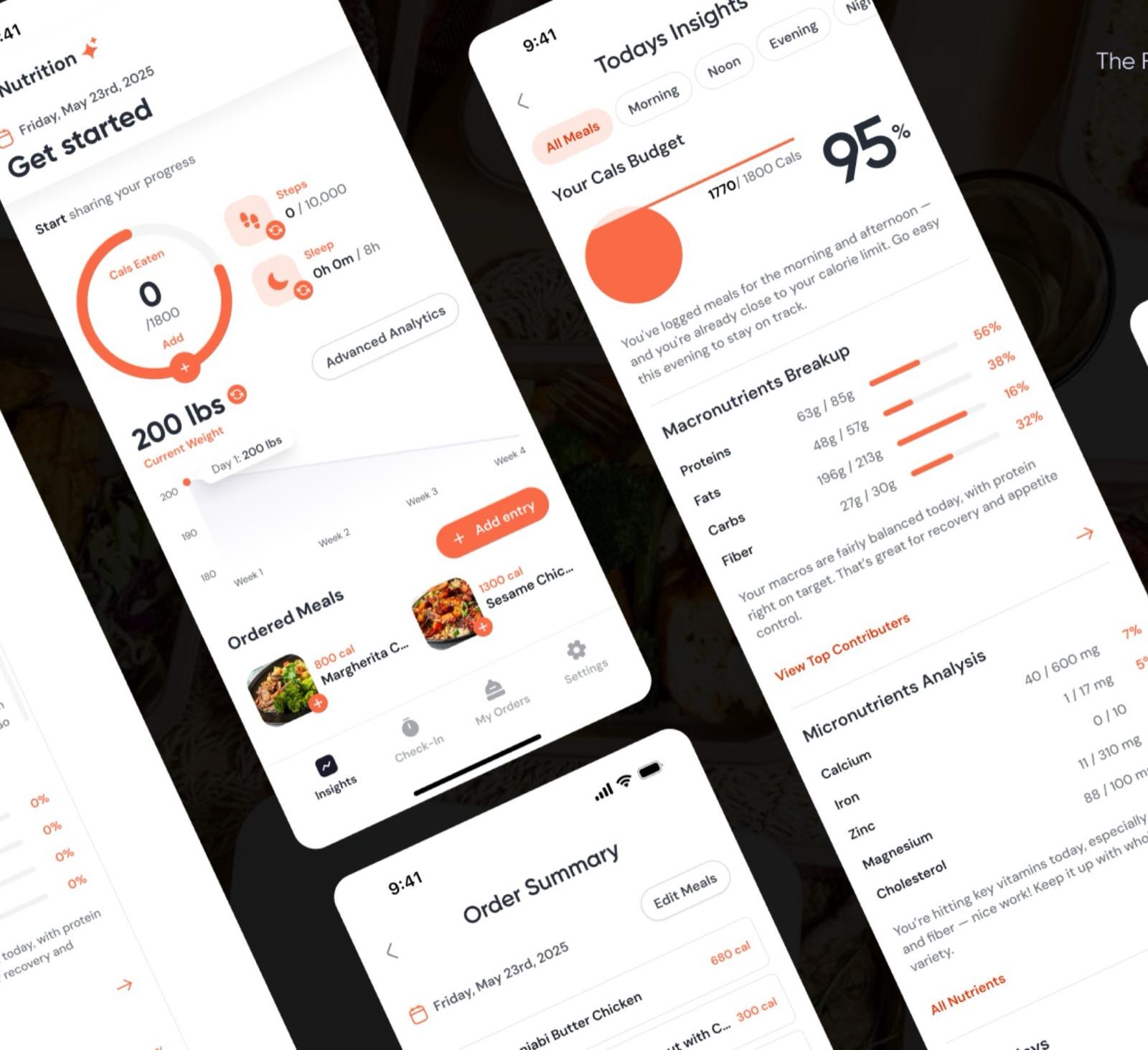
A client starts by telling the app what they are working toward, whether that is losing weight, gaining it, holding it or building muscle, and the planner turns that into a week with calorie and macro targets. This series of questions and answers are guided by a rich dataset of nutritional information.
For a new client there is no history to learn from, so the first plans come from calorie and macro heuristics approved by a registered dietitian. As the weeks go by the planner reads the client's weight trend, what they logged and what they were recommended, and it adjusts the plan to them.
With the day in front of it, the coach says what to do next in plain words, such as go easy this evening because you are close to your limit. Our team rebuilt the app around this coach, working through the flow with his own nutritionists, so it is the centre of the product.
Logging the day with computer vision
Since Instameals cook and deliver their own nutritionist vetted meals they already have a good idea of the macro and calories intake of the clients. For food eaten outside the app, the client takes a photo, and a Vision Language Model (VLM) estimates the calories and macros from the picture and logs it. This makes the data the AI nutritionist has on it’s users very accurate.
Choosing the meals
Every week the plan has to be filled from a menu that changes every seven days, with stock that depends on the city, and it has to respect the targets the previous two systems set.
A generic engine that suggests what other people bought falls apart under those conditions, so we built one on Instameals' own data. Our first step was a deep exploratory data analysis of what was collected historically. It listed the clients and their plans, the catalogue and its tags, the stock in each city, and the ratings and clicks people had already left behind, and it said which of those could carry a recommendation. While we were exploring the data we set the benchmark at the same time onto which we measured our models. Every change since has been measured against it and the benchmark is made to be ever growing.
The recommender is built from four parts:
Feature store
It holds the static features of each meal, such as tags and nutrition, and the live ones, such as stock per city, regional popularity and recent ratings. Everything is cached, so scoring never waits on the database.
Flavour profiles
Each client's ratings, both the ones they give and the ones their orders imply, become a profile. Each meal is matched to that profile by its content, so a new dish can be recommended before anyone has bought it.
Scoring engine
Every candidate meal gets one score from the preference match, global and local popularity, and a stock factor that steers away from what is about to run out. The weights are tuned by A/B test.
Batch optimizer
It fills the week's plan within its constraints of plan size, available stock and category variety, and it serves the result in under 200 milliseconds.
It runs on every weekly menu, per city and per plan, answers in under 200 milliseconds, and learns from every order that follows.
Benchmarked on what people bought
Over the first eight weekly menus in production, the share of recommended meals that clients put in their plan rose by six points, across more than eight thousand clients, and nearly every client now buys at least one recommended meal each week.
The numbers are one facet of the vision being realized. The other is that Mohammad now has the machinery to understand his clients. Every recommendation is logged against what the client went on to buy, so a question about how new clients behave, or which kinds of meals people come back to, is answered from the data, and the weekly menu is planned with it.
Keeping it truthful
A nutritionist has to be right every time, so the guardrails are part of the product. The coach answers within the plan's calorie and macro limits, and its advice is checked against the dietitian-approved rules before it is shown. The photo model is tested on the food Instameals clients eat, which includes a lot of South Asian dishes, and standard nutrition databases misjudge those portions by about twenty percent, so the model is tuned and benchmarked on them specifically. The data informed the kitchen too. When it showed that muscle-gain plans called for more high-protein meals than the menu carried, his chefs and nutritionists designed new ones.
What’s next
We now monitor the recommender and the AI nutritionist, we train and retrain the models when needed, and every menu is measured against the same numbers. Mohammad set out to make healthy eating take no effort. The kitchen took the cooking off his clients' hands, and the nutritionist now helps them take their daily habits into consideration one week at a time.
Start at kickoff.
Bring the stalled pilot, the data you don't trust, or the roadmap nobody signed off. Thirty minutes with Yacine. You'll leave knowing whether there is a project worth doing, and we'll say so if there isn't.